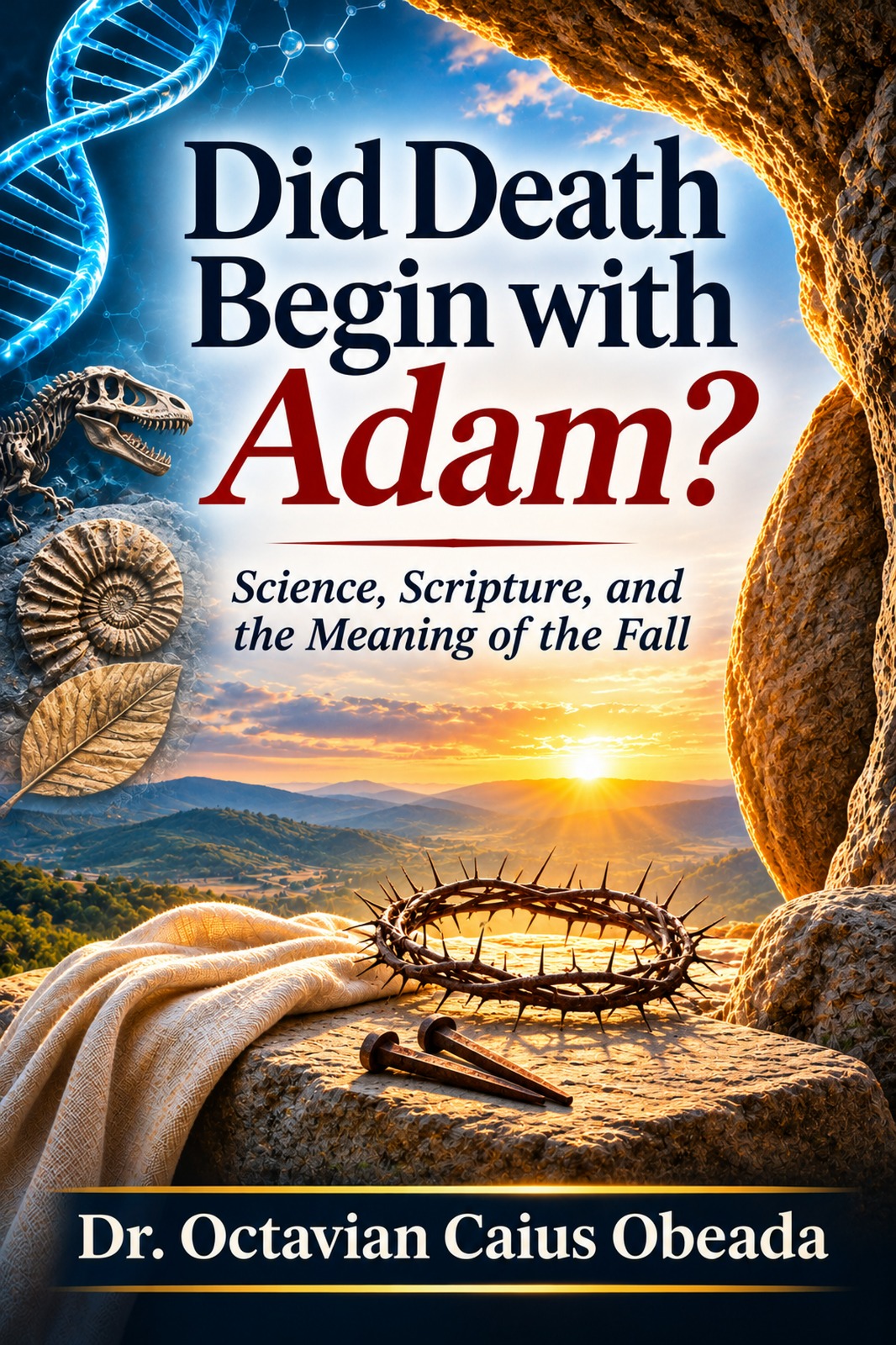
Did Death Begin with Adam?
Science, Scripture, and the Meaning of the Fall
Did death really begin with Adam?
Scripture declares that sin entered the world through Adam—and death through sin. Yet fossils reveal mortality, predation, disease, and extinction long before human beings appeared. Must Christians choose between the biblical account of the Fall and the scientific evidence of an ancient world?
In Did Death Begin with Adam? Science, Scripture, and the Meaning of the Fall, Dr. Octavian Caius Obeada brings together his background in medicine, theology, and Christian apologetics to confront this difficult question.
Beginning with the human body itself, the book asks a crucial question: What exactly is death? Is cellular death the same as animal mortality? Is biological mortality the same as the death Paul says entered through Adam?
Through an interdisciplinary examination of biology, fossils, human origins, Genesis, Romans, 1 Corinthians, and Christian theological tradition, Obeada argues that death before Adam and death through Adam are not contradictory claims. Biological mortality may precede humanity, while through Adam death enters the human story as judgment, condemnation, and alienation from God.
Affirming a historical Adam, a historical Fall, old-earth creation, and the significance of intelligent design, the book takes both scientific evidence and biblical authority seriously.
Ultimately, the question of death leads beyond Adam—to Christ.
The Christian answer to death is not found in the first organism that died, but in the Last Adam who entered the grave and rose again.
Publication details
- Category
- Book
- Book size / dimensions
- Paperback: 6 × 9 in (15.24 × 22.86 cm)
- Year
- 2026
- Planned formats
- Paperback | Kindle Version | eBook (Google Books) | eBook (Apple Books)
- Publisher
- Vox Dei Institute Press
Contents
PREFACE
INTRODUCTION
PART I – BIOLOGICAL DEATH BEFORE HUMANITY
CHAPTER 1: WHAT DOES IT MEAN TO DIE?
From Cellular Death to the Death of the Organism
Clinical Death and the Limits of a Moment
Organismal Death and the Survival of Parts
Cellular Death: An Irreversible Loss of Cellular Identity
Death Across the Levels of Life
Mortality, Vital Function, and the Medical Determination of Death
The Death of the Organism and the End of the Human Person
Organisms, Persons, and the Question of Identity
Animalism and the Human Being Who Thinks
Constitution without Identity
Substance Dualism and the Possibility of Separation
Hylomorphism and the Unity of the Human Being
One Death or Two?
Implications for Death Before Adam
CHAPTER 2: DEATH WITHIN LIFE: CELLULAR TURNOVER, AGING, AND SENESCENCE
Life Maintained through Cellular Death
Development through Subtraction
Immunity and the Discipline of Self-Removal
Tissue Maintenance and the Changing Body
Cancer and the Refusal of Cellular Limits
Molecular Damage and the Architecture of Aging
Telomeres: Clock, Barrier, and Cancer Defense
Cellular Senescence: Protection That Outlives Its Usefulness
Evolutionary Models of Senescence: Explanatory Scope and Limits
Longevity, Regeneration, and the Limits of Generalization
Could an Embodied Creature Live Indefinitely?
Created Mortality and Extraordinary Preservation
Death Within Life
CHAPTER 3: PREDATION, PARASITISM, DISEASE, AND ANIMAL SUFFERING
Predation as a Biological Relationship
Predators, Food Webs, and Ecological Structure
Competition and the Limits of Available Life
Pathogens, Parasites, and the Hidden Majority of Interactions
Nociception, Pain, and Conscious Experience
The Protective Function of Pain
Mortality Is Not Yet Suffering
Individual Suffering and Ecosystem-Level Goods
The Evidential Problem of Animal Suffering
Predation before the Fall
Evolutionary-Creation Theodicy and the “Only-Way” Argument
Intelligent Design, Functional Organization, and Suffering
Pain, Flourishing, and Excess
Alternative Theological Responses
Toward a Responsible Christian Interpretation
Creation’s Ambiguous Goodness
CHAPTER 4: THE FOSSIL RECORD: MORTALITY, EXTINCTION, AND DEEP TIME
Reading a fragmentary archive
From succession to deep time
Fossils as evidence of death
Predation written into bodies and sediments
Injury, disease, and survival
Ordinary extinction and the crises of the biosphere
Disruption, survival, and recovery
How firmly is prehuman death established?
Intelligent design and the evidential limits of the fossil record
What the stones cannot say
Mortality before Adam and the discipline of interpretation
PART II – HUMAN ORIGINS AND THE LOCATION OF ADAM
CHAPTER 5: HOMININ MORTALITY BEFORE ADAM
Hominin history is not a staircase
Anatomically modern humans
Neanderthals after the caricature
Denisovans and the recovery of an unseen population
Injury, disability, and the social world
Death, burial, and the danger of romantic reconstruction
Pigment, ornament, and symbolic life
Language and the invisible architecture of thought
Biological humanity and the rational animal
Moral agency is not simply intelligent behavior
The image of God and theological personhood
Where may Adam belong?
Mortality before theological Adam
What fossils and genomes can establish
Intelligent design, rationality, and human origins
The boundary of scientific competence
Ancient kin and Christian responsibility
CHAPTER 6: ADAM IN A WORLD ALREADY ACQUAINTED WITH DEATH
Death: capacity, event, and judgment
Original sin and transmission
Testing the models
Can Adam remain decisive?
PART III – DEATH IN GENESIS
CHAPTER 7: THE DEATH THREAT: “IN THE DAY THAT YOU EAT OF IT”
The command before the threat
Môt tâmût: what the Hebrew construction says
“In the day”: twenty-four hours or decisive occasion?
What actually happens when they eat?
Is “spiritual death” the right description?
Judgment as sentence
Exile as enacted death
Toil and the mortalization of ordinary life
Does the text teach that aging begins that day?
Mercy within the sentence
The serpent’s half-truth
Physical death cannot be removed
Relational and judicial death belong together
Death present and approaching
The apologetic significance of the warning
CHAPTER 8: DUST, BREATH, AND THE TREE OF LIFE
The earth-creature
The breath that makes dust live
Not a body plus a ghost
The garden as a place of provision
The two trees
The tree before sin
The tree after sin
Intrinsic and conditional immortality
Was Adam biologically mortal?
Life as gift rather than possession
The reappearance of the tree
Apologetic implications
From borrowed breath to incorruptible life
CHAPTER 9: THE CURSE AND THE CHANGED HUMAN CONDITION
What is actually cursed?
Continuity before and after the Fall
The ground: gift turned resistant
Childbearing and the anguish of life
“Your desire shall be for your husband”
Fractured relation before the sentence
Exile and the loss of sacred vocation
Condemnation
The certainty of human death
Did the wider creation change?
Corruption without ontological ruin
The first murder and death’s social reign
Natural death and penal death
Christ and the transformation of death
What, then, changes at the Fall?
Meaning is not “merely meaning”
Answering the guiding question
PART IV – ADAM AND DEATH IN THE NEW TESTAMENT
CHAPTER 10: “DEATH ENTERED THE WORLD THROUGH SIN”: ROMANS 5
The argument before Adam appears
A sentence that does not finish
“Through one man”
Sin “entered the world”
“And death through sin”
“And so death spread to all human beings”
Eph’ hō pantes hēmarton
Sin before the law
Adam, “a type of the one to come”
Trespass and gift
Condemnation and justification
The law enters alongside
Corporate solidarity
Jewish backgrounds to Paul’s Adam
Physical, spiritual, and eschatological death
Why Paul is not doing paleobiology
Does pre-Adamic hominin death create a harder problem?
Adam’s disobedience and Christ’s obedience
The danger of narrowing death too far
Death’s reign and human experience
Adam and the historicity question
The principal answer
CHAPTER 11: “IN ADAM ALL DIE”: RESURRECTION AND THE LAST ADAM
The dispute Paul actually addresses
“In Adam” and “in Christ”
The reign that destroys death
Seed, body, and divine agency
Corruption and incorruption
The first living being and the last life-giver
Does Christ restore Adam or surpass him?
“Flesh and blood cannot inherit”
Continuity, transformation, and personal identity
Resurrection rather than disembodied survival
The historical and apologetic center
Embodied hope and present practice
The last Adam and humanity’s intended end
CHAPTER 12: THE GROANING OF CREATION: ROMANS 8
The argument surrounding the groaning creation
What does “creation” mean?
Subjection to futility
Bondage to corruption
Groaning as labor, not despair
Does Romans 8 require animal death to begin at the Fall?
Cosmic redemption without a biological reset
CHAPTER 13: WHAT DEATH DID ADAM INTRODUCE?
Mortality is not yet death
Biological death before Adam
Bodily death becomes a human sentence
Condemnation and covenantal alienation
Spiritual death among the biologically living
Exile from divine life
Eschatological judgment and the second death
One drama, several dimensions
PART V – THE CHRISTIAN TRADITION ON MORTALITY AND THE FALL
CHAPTER 14: THE EARLY CHURCH: MORTALITY, CORRUPTION, AND LIFE WITH GOD
Reading the Fathers without anachronism
Irenaeus: infancy, growth, and incorruptibility
Athanasius: from corruption toward non-being
Basil: providence within animal life
Gregory of Nyssa: animal nature and the garments of mortality
Chrysostom: Adam, cosmic corruption, and moral exhortation
The animal question in historical proportion
Diversity within a shared theological grammar
CHAPTER 15: AUGUSTINE TO THE MODERN ORIGINS DEBATE
Augustine: Mortality as a Modal and Theological Condition
Aquinas: A Corruptible Body Preserved by Original Justice
Luther and Calvin: The Fall as Human Catastrophe
Fossils Before Darwin: A New Kind of Historical Evidence
Fundamentalism Before Flood Geology
What the Historical Trajectory Shows
PART VI – COMPETING MODELS OF DEATH BEFORE ADAM
CHAPTER 16: NO ANIMAL DEATH BEFORE THE FALL: THE YOUNG-EARTH MODEL
The Young-Earth Case at Full Strength
Where the Exegetical Inference Tightens
Carnivorous Design and the History Recorded in Bodies
Can the Flood Carry the Fossil Record?
Is the Gospel at Stake?
CHAPTER 17: PRE-ADAMIC DEATH: OLD-EARTH, EVOLUTIONARY, AND INTELLIGENT-DESIGN MODELS
Old-Earth Creationism: Death Without Adamic Condemnation
Evolutionary Creation: Continuity and the Threshold of Moral Agency
Historical Adam Within an Ancient Population
Intelligent Design: A Causal Inference, Not an Anthropology
Comparing the Models Without Category Errors
PART VII – THEOLOGICAL AND APOLOGETIC RESOLUTION
CHAPTER 18: WAS A DEATH-FILLED WORLD “VERY GOOD”?
“Very Good”: Function, Value, and Eschatological Perfection
Pain: Protection Purchased at a Cost
Predation and the Ambiguity of Ecological Flourishing
Extinction: Death of Organisms and Loss of Forms
Evolutionary and Animal Theodicies
Scale, Probability, and the Evidential Problem
Permission, Purpose, and the Risk of Overexplanation
Goodness Without Denial
CHAPTER 19: DOES DEATH BEFORE ADAM UNDERMINE THE GOSPEL?
What Enters Through Adam?
Solidarity: Adam and Christ, Not Adam and Trilobites
Atonement Addresses More Than the Fact of Dying
Why Death Remains an Enemy
The Resurrection as Historical and Ontological Victory
Cosmic Renewal Beyond Human Rescue
The Apologetic Objection Reconsidered
The Last Adam and the End of Death
FINAL CONCLUSION: DEATH BEFORE ADAM AND DEATH THROUGH ADAM
The Question That Must Be Answered
What the Scientific Record Warrants
Mortality Is Not Yet the Reign of Death
Adam and the Human Rupture
Romans 5 and the Scope of Paul's Claim
First Corinthians 15 and the Meaning of Victory
Romans 8 and the Groaning Creation
Why Biological Antiquity Does Not Trivialize Death
Providence Without a God of the Gaps
Historical Adam in an Ancient Human Story
The Fall Is More Than Inevitable Finitude
The Last Adam and the Transformation of Mortal Persons
The Answer
CITED OR RECOMMENDED LITERATURE
ABOUT THE AUTHOR

Did Death Begin with Adam?