When Your Child Is Losing Faith is not merely another addition to apologetic literature; Dr. Caius Obeada’s book addresses a critical need: responding to today’s teenagers' questions in a way that nurtures and preserves their faith in God. The author guides us through a journey that begins by diagnosing the cultural and religious landscape, moves to understanding the questions teenagers are asking and formulating wise responses, and ultimately considers how to create environments where they can preserve and live out their faith. I highly recommend this book to anyone who engages with teenagers, parents, educators, and church leaders alike.

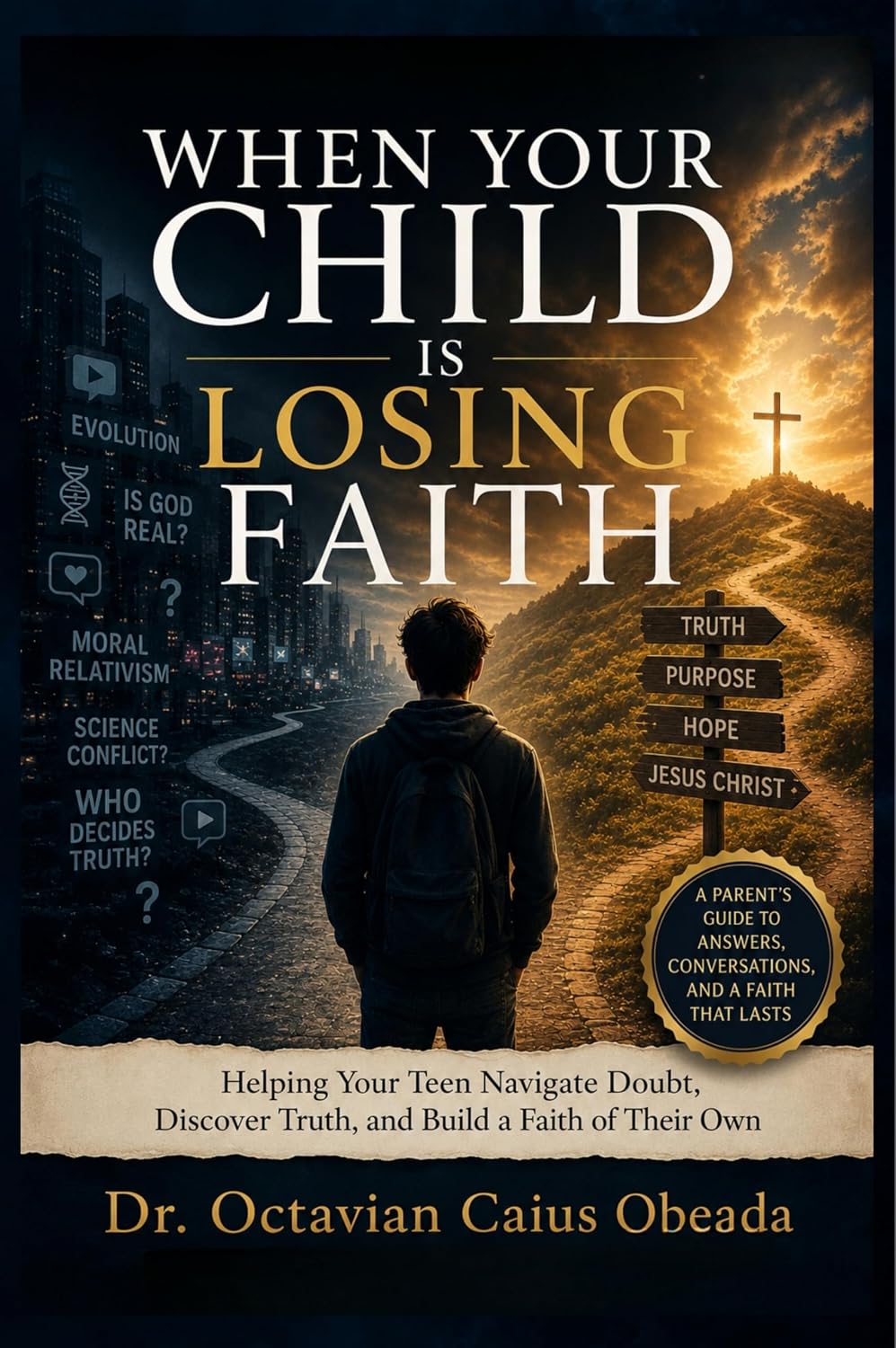
When Your Child Is Losing Faith
Today's teenagers are growing up in a world where every belief is questioned and every worldview competes for their attention. Through social media, classrooms, podcasts, and online communities, they encounter challenging questions about God, the Bible, science, morality, suffering, and the uniqueness of Jesus Christ. Many Christian parents sincerely desire to help, but often feel unprepared to answer the questions their children are asking.
When Your Child Is Losing Faith is an apologetics resource written for parents who want to guide their children with both intellectual honesty and Christian conviction. Rather than offering simplistic answers or encouraging parents to shield their children from difficult questions, this book demonstrates how thoughtful inquiry can strengthen rather than weaken, genuine faith.
Drawing on philosophy, theology, history, developmental psychology, and contemporary apologetics, Dr. Octavian Caius Obeada explores why adolescents begin to question their beliefs, how identity formation shapes spiritual development, and why intellectual, emotional, moral, and cultural influences all contribute to the journey from inherited faith to personal conviction. Parents will learn how to distinguish between scientific evidence and philosophical interpretation, evaluate common objections to Christianity, engage difficult conversations with confidence, and cultivate an environment where truth is pursued with humility and integrity.
This book is not about winning arguments or preserving outward religious conformity. It is about equipping parents to help their children build a faith that is freely embraced, carefully examined, and firmly grounded in the truth of the gospel. A faith that can withstand honest questions is often the faith that endures for a lifetime.
Publication details
- Category
- Book
- ISBN-13
- 9798953063005
- Book size / dimensions
- Paperback: 6 × 9 in (15.24 × 22.86 cm)
- Year
- 2026
- Available formats
- Paperback | Kindle | Google Books | Apple Books
- Publisher
- Vox Dei Institute Press
Contents
PREFACE
INTRODUCTION
PART I – UNDERSTANDING YOUR TEEN
CHAPTER 1: WHY ADOLESCENCE CHANGES EVERYTHING
Adolescence Is Not a Problem to Fix but a Person Becoming an Adult
Why Emotion Often Speaks Louder Than Reason
Designed to Explore – Why Adolescence Is a Season of Learning, Not Simply Risk
The Environment That Shapes the Heart - Helping Your Teen Develop a Faith That Lasts
CHAPTER 2: HOW FAITH DEVELOPS DURING THE TEEN YEARS
CHAPTER 3: UNDERSTANDING YOUR TEEN
Why Good Kids Begin to Doubt
PART II – UNDERSTANDING THE QUESTIONS
CHAPTER 4: INTELLECTUAL DOUBTS
Doubt Is Not the Opposite of Faith
The Desire for Evidence: Christian Faith in a Scientific Age
Scripture, Resurrection, and the Problem of Suffering
What Does It Mean to Call the Bible Reliable?
Approaching Alleged Contradictions
Why the Resurrection Matters
Alternative Explanations
The Problem That Does Not Disappear
Emotional Pain and Philosophical Argument
Religious Diversity, Christian Truth, and the Foundations of Morality
What Religious Diversity Does—and Does Not—Prove
Geography, Culture, and Religious Belief
Exclusive Claims Without Arrogance
Can People Be Moral Without God?
Does Morality Depend on God?
Common Objections Teenagers Encounter
Teaching Conviction with Intellectual Hospitality
Questions Can Become Doorways to Stronger Faith
CHAPTER 5: EMOTIONAL DOUBTS
When the Heart Questions Before the Mind
Pain, Loss, and Spiritual Disillusionment
Shame, Emotional Health, and the Need to Belong
Guilt, Shame, and the Fear of Rejection
When Anxiety and Depression Affect Faith
The Adolescent Need to Belong
Healing Often Precedes Conviction
CHAPTER 6: MORAL QUESTIONS
When “Is It True?” Becomes “Why Should I Obey?”
Who Decides What Is Right and Wrong?
Can I Be a Good Person Without God?
Morality Flows from Relationship with God
CHAPTER 7: SCIENCE, TECHNOLOGY, AND SOCIAL MEDIA
Growing Up in a Digital World: How Social Media Shapes a Worldview
Science and Faith: Learning to Listen Beyond the Headlines
Artificial Intelligence and the Rise of Online Skepticism
Digital Communities, Information Overload, and the Formation of Attention
Information Is Not Yet Wisdom
Attention as a Formative Capacity
Truth Endures in Every Generation
PART III – RESPONDING WISELY
CHAPTER 8: HOW TO LISTEN WITHOUT PANIC
Your First Response Matters
Listen to Understand Before You Respond
When You Do Not Know the Answer
Listening Is the Beginning of Restoration
CHAPTER 9: CONVERSATIONS THAT BUILD TRUST
Trust Is Built One Conversation at a Time
Asking Questions That Invite Reflection
Talking About Difficult Topics with Confidence
The Gospel Is Heard Best Through Trusted Relationships
CHAPTER 10: ANSWERING THE TOUGH QUESTIONS
You Don't Have to Be an Expert
Addressing the Most Common Questions
Teaching Your Child How to Think
Pointing Beyond Arguments to Christ
Faith That Can Withstand Honest Questions
CHAPTER 11: WHEN YOU DON'T KNOW THE ANSWER
It's Okay Not to Know
Distinguishing Essential from Secondary Questions
Evaluating Sources While Living with Unanswered Questions
Trusting God While Seeking Understanding
Humility Is Not Weakness but Wisdom
CHAPTER 12: LOVING WITHOUT COMPROMISING
The Tension Every Christian Parent Feels
Keeping the Relationship Strong
Setting Healthy Boundaries Without Parenting from Fear
Love That Reflects the Heart of the Father
PART IV – BUILDING A FAITH THAT LASTS
CHAPTER 13: CREATING A HOME THAT ENCOURAGES FAITH
Home Is the First Place Faith Is Learned
Reading Scripture and Praying Together
Cultivating Character Through Everyday Family Life
Preparing Children for the World and Leaving a Legacy of Faith
A Home Where Faith Can Take Root
CHAPTER 14: PREPARING YOUR TEEN FOR COLLEGE AND ADULTHOOD
The Transition from Borrowed Faith to Personal Faith
Preparing for Intellectual Challenges
Choosing Healthy Friendships
Releasing with Faith
CHAPTER 15: HOPE FOR PARENTS
Faithfulness Without Perfection
When Your Adult Child Chooses a Different Path
Trusting God with the Harvest
Hope Anchored in the Faithfulness of God
CITED OR RECOMMENDED LITERATURE
ABOUT THE AUTHOR
It has been said that we do not live in the information age, but the misinformation age. Parents did not grow up facing the same level of doubt, confusion, and cultural pressure that younger generations face today, and many are unprepared for the questions their children bring home. For those parents, this book is a lifesaver. Dr. Obeada does not merely offer soundbite answers; he provides a map to help parents carefully navigate their children through the difficult cultural terrain they face. This is the kind of resource that Christian parents need in their home.
This book is an important resource, especially for parents, but also for those working with adolescents and young adults. The book examines how faith develops during adolescence, why seemingly committed young people begin to doubt, and how intellectual, emotional, moral, scientific, and technological influences shape their interpretation of Christianity. It then turns to how parents can help build a faith that can survive beyond the shelter of the home. A major conclusion of this book is that when inherited faith is challenged by a competing world, parents have the opportunity to help their children move beyond unexamined faith to a Christianity that is understood, tested, and personally affirmed.
In When Your Child Is Losing Faith, Dr. Caius Obeada offers a thoughtful and balanced exploration of the questions Christian parents face as their children begin to examine inherited beliefs. Drawing on Scripture, Christian Apologetics, and insights into adolescent development, he encourages parents to respond with understanding, intellectual honesty, and biblical conviction. I appreciate the way Dr. Obeada brings careful reasoning together with like pastoral sensitivity, helping parents take their children’s questions seriously while remaining faithful to the truth of the Gospel. This book is a valuable contribution to the work of Christian discipleship, equipping parents and even pastors, to nurture a personally examined faith through patient conversation, a credible Christian witness, and confidence in God’s faithfulness.
We live in an unprecedented cultural and intellectual ecosystem where the younger generation no longer encounters objections to faith merely in university lecture halls or philosophical treatises, but continuously absorbs them through screens, social media networks, recommendation algorithms, and emerging artificial intelligence platforms. Confronted with this relentless influx of digital skepticism, moral relativism, and aggressive scientism, Dr. Octavian Caius Obeada’s work stands out as a monument of conceptual clarity, apologetic rigor, and theological balance.
The fundamental and distinctive value of this volume lies in its flawless interdisciplinary architecture. The author masterfully builds a bridge between adolescent developmental neuroscience, identity psychology, and classical as well as contemporary Christian apologetics. With exceptional philosophical precision, Dr. Obeada demonstrates that Christian faith is not a mere therapeutic preference or family custom, but a public claim about reality—firmly anchored in the historicity of Christ's Resurrection, the reliability of Scripture, and a rationally coherent worldview. Simultaneously, the author brilliantly exposes the presumed neutrality of scientism and metaphysical naturalism, showing that genuine science and Christian revelation do not invalidate each other, but rather converge in an honest search for truth.
From a pedagogical and pastoral standpoint, the book provides liberating insight: a teenager’s doubt is not necessarily a sign of rebellion or spiritual collapse, but often the internal laboratory where a borrowed, inherited faith is tested and examined to become a mature, personally owned conviction. Dr. Obeada equips parents and leaders to overcome defensive panic and turn confrontation into restorative dialogue, offering not simplistic formulas or religious clichés, but a robust theological and rational anchor capable of withstanding the storms of the modern world. I whole-heartedly recommend this exceptional work to all parents, pastors, educators, and mentors seeking to guide today's youth toward an enduring, intellectually robust faith firmly rooted in Jesus Christ.

When Your Child Is Losing Faith